|
Dan Montgomery writes: “When the interview committee asked why I was interested in the executive director position, I replied, doing my best impression of famed mountaineer George Mallory: ‘Because it’s the ALA!’ I was responding, of course, to my belief in libraries and in the right to read, both of which have been under serious attack.
And library workers and advocates who defend reading, books, and unfettered access to knowledge are critical to protecting American democracy.
So, to be part of the organization most squarely in the forefront of that cause seemed to me an unmissable opportunity, and a great honor.”...
American Libraries column, Nov./Dec.
| |
|
ALA announced on November 6 the
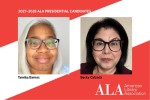
candidates running for ALA president for the 2027–2028 term: Tamika Barnes, associate dean of Perimeter College Library Services at Georgia State University in Atlanta, and Becky Calzada, district library coordinator at Leander (Tex.) Independent School District.
The ALA Nominating Committee also
announced candidates for 12 councilor-at-large seats. Barnes and Calzada, as well as any petition candidates for president, will take part in a virtual candidates’ forum to be scheduled in winter 2026. Ballot mailing for the election will begin March 9, 2026, and will run through April 1....
AL: The Scoop, Nov. 6
| |
|
Greg Landgraf writes: “Growing up, Steve Spohn’s primary way to connect with others was through videogames.
Diagnosed with spinal muscular atrophy as an infant, Spohn spent significant time in the hospital as a child [where he could only play with others through the hospital’s gaming system]. Spohn, director of the Mount Sinai Back to Life Center in New York City and former chief operating officer of AbleGamers, worked with Deerfield (Ill.) Public Library to host an open-house-style Adaptive Arcade event, featuring a PlayStation 5, a Nintendo Switch, and a gaming PC for use with games such as Rocket League and the Mario Kart series.”...
American Libraries feature, Nov./Dec.
| |

|
|
|
For the first time since 2018, ALA will host the National Library Legislative Day February 25–26, 2026. The event will combine advocacy education, networking, and in-person meetings with legislators and congressional staff.
Interested participants must complete an interest form by December 12 to be considered, as capacity is limited to 235 people and ALA is working to ensure equitable state representation.
During the February 25 training portion, participants will share advocacy stories, learn from policy experts, and strategize for meetings on Capitol Hill the next day....
ALA Public Policy and Advocacy Office, Nov.
10
| |
|
On November 5, ALA, Unite Against Book Bans, and the Interfaith Alliance launched the “Faith for Libraries: Diverse Faith Communities Supporting Libraries and Librarians” campaign to defend the freedom to read.
The organizations have launched a
pledge for people of faith to defend the freedom to read, and a campaign for houses of worship to
send supportive postcards to their local librarians.
They will also announce a major event in Chicago next year to coincide with ALA’s Annual Conference....
ALA Public Policy and Advocacy Office, Nov.
5
| |
|
Amanda Jones, the Livingston Parish (La.) school librarian who
became one of the first librarians to sue book-banning activists for defamation after relentless assaults on her character, has received an apology from one of the critics who accused her of giving inappropriate materials to children.
Jones settled her lawsuit against Ryan Thames, who operates the Bayou State of Mind Facebook page, for
$1 and an apology, in which he acknowledged that his claims about her were not true....
Louisiana Voice, Nov.
3; American Libraries feature, Sept./Oct. 2023; Instagram, Nov. 2
| |

|
|
|
While there were relatively few local elections in the US November 4, several that were held delivered good news for libraries.
Washington County, Oregon,
approved a library levy increase from 22 to 37 mills. School board members who had supported book bans lost in
Cypress-Fairbanks (Tex.) Independent School District. In Ohio,
18 of 20 public library levies passed, and voters rejected
several school board incumbents who ran on culture-war issues including banning books.
In Pine-Richland School District in Gibsonia, Pennsylvania, a slate of candidates opposing the
school board’s new policy giving themselves power to add or remove library books,
won the majority of board seats....
OregonLive, Nov. 5; Houston Press Nov. 5; Cleveland.com, Nov. 5; Signal Ohio, Nov. 10; TribLive (Pittsburgh), Mar. 18, Nov. 5
| |
|
Kristen Griffith writes: “Maryland’s school board is reversing Harford County’s removal of a book from public school libraries.
The November 4 decision comes after the
Harford County school board banned the young adult graphic novel Flamer by Mike Curato last summer.
The local board had overruled the superintendent and a review committee who had decided to keep Flamer in middle and high school libraries.
This is the first time the state board has ruled on a local book ban since the 2024 passage of Maryland’s
Freedom to Read Act.”...
Baltimore Banner, Nov.
5; Sept. 10; American Libraries feature, June
| |
|
Corey Halaychik writes: “Libraries have long been the backbone of academic and public access to knowledge.
But over time, we have handed over too much control to vendors—companies that provide us with books, databases, discovery systems, and other essential services.
If we continue down this path, we risk losing our ability to shape the future of information access.
But libraries don’t have to be passive consumers of vendor products.
We can be creators, leaders, and innovators.
The question is: Are we ready to take that step?”...
International Federation of Library Associations and Institutions, Nov.
7
| |

|
|
|
John Herrman writes: “Drawing on a new global survey of 250,000 adults in 50 countries by analytics firm GWI, John Burn-Murdoch at the Financial Times provocatively argues that, amidst all the fervor about artificial intelligence, another consequential story is unfolding
more quietly: ‘In years to come, we may well look back on September 2025 as the point at which social media jumped the shark and began rapidly accelerating its transition from the place to be seen,’ he writes, ‘to a gaudy backwater of the internet inhabited by those with nothing better to do.’”...
New York Magazine: Intelligencer, Nov. 10; Financial Times, Oct.
3
| |
|
Rodney Freeman Jr. writes: “We are living through a period of profound uncertainty and systemic challenge—where erasure of truth and history is not only possible but actively underway.
History is protected by those who collect, preserve, and share the facts, and the archive becomes a battleground where every saved story is an act of resistance.
The future will only remember what is preserved today, and the choice is between standing by as stories are diluted or destroyed—or fighting for the record, for the archive, and for the truth with steady, everyday work that anyone can participate in.”...
Common Dreams, Nov. 2
| |
|
Bobbi L. Newman writes: “I know many of us are struggling right now.
When we think about self-care or rest, most of us default to the physical, things like getting enough sleep, maybe squeezing in a workout, or taking a vacation day.
And those things matter.
But if you’re someone who sleeps eight hours a night, takes your lunch away from your desk, and still feels depleted? You’re not doing self-care wrong. You might be missing the other six types of rest your body and mind need.”...
Librarian By Day, Nov.
6
| | |

|
|
|
American Libraries Direct is a free electronic newsletter emailed every Wednesday to personal members of ALA.
Editor, AL Direct: Greg Landgraf
Direct ad inquiries to: Melissa Carr
Send news and feedback: AL Direct
All links outside the ALA website are provided for informational purposes only. Questions about the content of any external site should be addressed to the administrator of that site. AL Direct FAQ.
American Libraries will not sell your email to outside parties, but your email may be shared with advertisers in this newsletter should you express interest in their products by clicking on their ads or content. If advertisers choose to communicate with you by email, they are obligated to provide you with an opportunity to opt-out from future emails in compliance with the CAN-SPAM act of 2003 and the European Union’s General Data Protection Regulation of 2018. Read the ALA privacy policy.
To manage your American Libraries email preferences, click here.
To unsubscribe from all ALA emails, click here.
American Library Association | 225 N. Michigan Avenue, Suite 1300 | Chicago, IL 60601
|
|
|
|
|
|
|
|






.jpg)