|
Donald W. Crankshaw writes: “Traditional professional development plans in libraries may satisfy organizational or certification needs but do not necessarily satisfy employees’ needs, wants, and interests.
What if we put employees’ needs and wants center stage by looking at professional development through the lens of an employee well-being program? A well-being program is an investment in the whole person, not just the part that is an employee, and therefore the concept of professional development can easily be built into a well-being program.”...
American Libraries feature, Nov./Dec.
| |
|
Terra Dankowski writes: “Sean Sherman, founder of the restaurant Owamni in Minneapolis, was not widely known in 2017, when he released his first cookbook.
Since then, he has become perhaps the most recognizable Indigenous chef in the country, racking up James Beard Foundation and Julia Child awards for his food and advocacy.
Sherman spoke with American Libraries about this extensive collection, his early influences, and his love for libraries.
Sample a recipe from Sherman’s new cookbook, Turtle Island: Foods and Traditions of the Indigenous Peoples of North America (November, Clarkson Potter), written with Kate Nelson and Kristin Donnelly.”...
American Libraries Trend, Nov./Dec.
| |
|
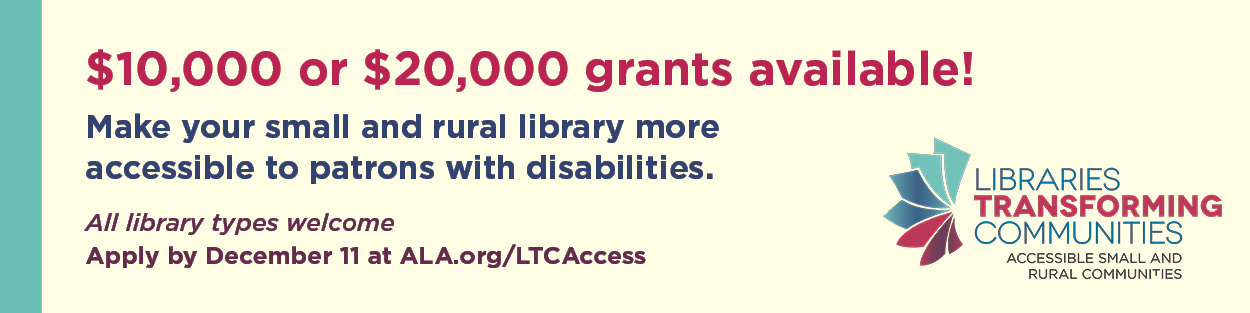
Small and rural libraries of all types are invited to apply for the Libraries Transforming Communities: Accessible Small and Rural Communities grant, offering awards of $10,000 or $20,000 to support projects that advance accessibility and inclusion for patrons with disabilities.
Funding may be used for facility improvements, adaptive technologies, staff training, or inclusive programs and services.
This initiative aims to help libraries reduce barriers and create welcoming environments for all members of the community.
Applications are due December 11.
|
| |

|
|
|
Anne Ford writes: “For David Sleasman, librarian at the Brian Sutton-Smith Library and Archives of Play in Rochester, New York, receiving 27 storage tubs full of literature about checkers is all in a day’s work. Sleasman, along with two catalogers and two archivists, wrangles 260,000 library holdings, 3,000 linear feet of physical archives, and nine terabytes of digital archives, all pertaining to the history of play.
The library and archives are housed at the Strong National Museum of Play, where visitors romp through exhibits of toys through the ages, play pinball on vintage machines, and navigate a ropes course.”...
American Libraries feature, Nov./Dec.
| |
|
Robin Camille Davis writes: “So you’ve heard about the upcoming
new accessibility requirements for US state and local government websites, and you’ve implemented an automated accessibility checker and fixed all the issues you found.
You’re done, right? Wrong! Automated accessibility checkers are really useful for spotting common issues, such as color contrast problems and broken web forms.
But there are some things that automated checkers can’t determine. Here are five simple but significant things to check when you’re creating or editing web content.”...
Choice 360: LibTech Insights, Nov.
17
| |
|
Emma Kell writes: “I have been passionate about American Sign Language since I was young and went to my local library to take out every book they had that could teach me the language.
Lately I’ve been wondering how we as librarians can best serve the Deaf kids who come through our doors.
I’ve compiled some of the ways I’ve made the library a more accessible place, either during my time working at a school for the Deaf or in my current position as a children’s librarian at a public library, and some ideas to implement in the future.”...
ALSC Blog, Nov. 14
| |

|
|
|
Mary Davis Fournier writes: “This white paper reflects the insights of more than 350 public libraries nationwide, gathered through a survey, case studies, and supporting research.
It offers a detailed look at how libraries are addressing adult learning needs, the barriers patrons face, and the innovative approaches shaping the future of lifelong learning.” The white paper highlights the high demand for adult education and libraries’ increasing innovation in providing programs, while noting that unstable funding and limited digital literacy among learners are significant challenges....
Public Library Association, Nov.
12
| |
|
Hamilton Matthew Masters writes: “Tennessee public libraries are launching an ‘immediate age-appropriateness review’ of children’s and teens’ books following a state government directive, with some calling the plan ‘anti–public-library.’ On November 5, the Rutherford County Library System announced an ‘emergency closure notice’ of varying dates for multiple libraries.” Tennessee Secretary of State Tre Hargett
sent letters to several libraries ordering reviews and warning that noncompliant libraries could lose state and federal funding....
Nashville Scene, Nov.
10; Rutherford County (Tenn.) Library System, Nov.
5; Erin in the Morning, Nov.
11
| |
|
Seth M. Porter writes: “For many, their first experience with access to high-performance computing and high-speed internet was at a local library.
Just as libraries once opened the door to high-performance computing and the internet, they can help make quantum computing accessible.
Quantum computing uses the principles of quantum mechanics to process information in ways that allow certain problems to be solved exponentially faster than with classical computing.
It may still be years from scaled commercial use, but the revolution is no longer theoretical, and I believe libraries should be at its center.”...
Katina, Nov. 13
| |

|
|
|
Tyler A. McNeil writes: “More people claim they voted for a Stephentown (N.Y.) Memorial Library budget proposal than what was reported in unofficial election results on Nov.
4. The proposition asked voters to approve a $15,000 increase in the town’s annual contribution to the library’s operating budget. Unofficial election results reported 528 no votes and 60 yes votes—a result that left some community members and the library board's president, Jennifer Peabody, in disbelief and wondering if voting machines had experienced technological issues.” By November 13, the library had collected
sworn statements from 240 voters affirming they had voted in favor of the measure....
Albany (N.Y.) Times Union, Nov. 12; Stephentown (N.Y.) Memorial Library, Nov.
13
| |
|
Nathan Hull writes: “I have a prediction for the future of audio consumption.
In fact, some may argue it has quietly existed on some platforms already.
Imagine a scenario where you pay one fee for your standard single voice recordings, but you pay a levy for premium audio featuring multi-cast, fully scored audio entertainment, and cinematic sound design that turns every listen into a full-blown experience. The option is enticing.
Two-tier platforms will become the norm: Straight reads at a lighter price, premium super-productions at another.”...
The Bookseller, Oct. 30
| |
|
Marialuisa Monda writes: “Every November, we celebrate the traditions, languages, rituals, contributions, rich identities, and stories of Native American, Alaska Native, Native Hawaiian, and affiliated Island communities.
I want to share some of the books that I absolutely love by Indigenous writers.
I also highly recommend exploring
this ongoing, collaborative list—created in partnership with Folio: The Seattle Athenaeum—featuring reading recommendations that celebrate Indigenous American writers past, present, and future....
New York Society Library, Nov.
12
| | |

|
|
|
American Libraries Direct is a free electronic newsletter emailed every Wednesday to personal members of ALA.
Editor, AL Direct: Greg Landgraf
Direct ad inquiries to: Melissa Carr
Send news and feedback: AL Direct
All links outside the ALA website are provided for informational purposes only. Questions about the content of any external site should be addressed to the administrator of that site. AL Direct FAQ.
American Libraries will not sell your email to outside parties, but your email may be shared with advertisers in this newsletter should you express interest in their products by clicking on their ads or content. If advertisers choose to communicate with you by email, they are obligated to provide you with an opportunity to opt-out from future emails in compliance with the CAN-SPAM act of 2003 and the European Union’s General Data Protection Regulation of 2018. Read the ALA privacy policy.
To manage your American Libraries email preferences, click here.
To unsubscribe from all ALA emails, click here.
American Library Association | 225 N. Michigan Avenue, Suite 1300 | Chicago, IL 60601
|
|
|
|
|
|
|
|





.jpg)


 (002)-resized.png)