EDITOR'S NOTE
As we were preparing to send this issue, the Institute of Museum and Library Services announced that it was reinstating all federal grants. Read the full news release.
|
|
|
|
Rachel Rosenberg writes: “To remain relevant, libraries are constantly evolving.
Consider that our institutions were once places of enforced silence, but today are community hubs that welcome conversation, interaction, and playtime.
As librarians, we aim to add value to people’s lives by planning and implementing programming for all ages.
These books, and their out-of-the-box ideas, will help you to find new and meaningful ways to serve patrons.”...
American Libraries column, Nov./Dec.
| |
|
Anne Ford writes: “With total earnings of $441,600, Adriana Harmeyer, clinical associate professor and archivist for university history at Purdue University in West Lafayette, Indiana, is the winningest library professional ever to have appeared on the legendary game show Jeopardy! Harmeyer—who holds the 12th-longest consecutive winning streak of any player on the show—spoke with American Libraries about her longtime love of the game, her least favorite category, and how she blazed her path to the 2025 Jeopardy! Masters tournament.”...
American Libraries feature, Nov./Dec.
| |
|
On November 26, ALA’s Games and Gaming Round Table named winners of the 2025
Platinum Play Awards. The “Platys” recognize outstanding games for library collections or programming ideas across a wide swath of library types in three categories: Board or Card Games, Tabletop Role-Playing Games, and Videogames.
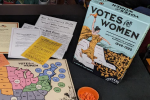
2025 Platinum Play winners are Cascadia; Votes for Women; No Thank You, Evil!; and Sodalitas. Additionally, the Platys Classics recognize games more than 10 years old; this year’s honorees are Clue, Jenga, Pokémon, Magic: The Gathering, Apocalypse World, Call of Cthulhu, Mario Kart 8, and Tony Hawk’s Pro Skater....
ALA Games and Gaming Round Table, Nov.
26
| |

|
|
|
Danya Leebaw and Erinn Aspinall write: “Leading in ambiguity is an intrinsic but under-discussed role of a middle manager.
Often, middle managers are dealing with personnel and operational situations in which there is no clear or obvious choice, no clear guidance, or no full understanding of the context.
Yet middle managers still have to lead, make decisions, and communicate and facilitate change with less than perfect information.
This article reviews relevant literature on ambiguity and management and explores two scenarios where we will introduce established management tools that can help lead through—and in synergy with—ambiguity.”...
Library Leadership and Management, Vol.
39, No. 1 (Nov. 25)
| |
|
Caitlin Keenan writes: “You updated your borrowing information six months ago to reflect a change in fee structure, and now you discover the original (outdated) content is still alive and well in a LibGuide maintained by the front desk staff.
Content chaos can feel like a way of life for web librarians.
We dream of a world where our content is discoverable, logically interrelated, current, accurate, and consistent, but getting there with the limited tools and authority granted to us can feel impossible.
Enter the cross-platform content model.”...
Choice 360: LibTech Insights, Dec.
1
| |
|
Catherine Hollerbach writes: “Public libraries built decades ago are often not well suited for the way libraries are used in 2025. Typically, there are too few windows, tall shelves, a lot of brick, and a lack of comfortable seating.
Customers now expect bright buildings with dedicated spaces that provide the programs and services they need in a comfortable, well-maintained environment.
They also want to know that their tax money is being spent thoughtfully and responsibly.
Here are some ideas for how to spruce up your library’s space without spending millions of dollars for a full renovation or building replacement.”...
Public Libraries Online, Dec.
2
| |

|
|
|
Lily Meyer writes: “Everyone from parents to publishers is susceptible to undervaluing board books.
It’s easy to dismiss them, as they are intended for children not only too young to read, but too young to even follow a story.
Can’t we just show a baby anything? We shouldn’t. Beginning in utero, one of the greatest benefits of shared reading is bonding, and the more engaged parents are in the book they’ve chosen, the greater its impact.”...
Mother Jones, Nov. 26
| |
|
Jane Jiang writes: “All too often, the library is not fully included in conversations that guide student learning and academic support.
When the library is treated as background infrastructure rather than as an active learning environment, the entire academic mission is weakened.
Students lose access to research instruction.
Faculty lose collaborators who can reinforce critical thinking and source evaluation.
Institutions lose a key space where academic integrity, inclusion, and intellectual curiosity are nurtured, and the larger research community loses a vital foundation for sustaining these principles.”...
The Scholarly Kitchen, Dec.
2
| |
|
Anthony Sinnott writes: “Despite the undeniable advantages of e-books, what at first glance seems like a demonstration of the decline of print, in fact shows a story of the persistence of print. Despite tech advancement, print books stubbornly persist on library shelves. This post explores five core reasons why physical books continue to hold a vital place in the digital library ecosystem.” Also read about the
enduring appeal of printed children’s books and the
importance of print for communities....
Librarianth, Nov. 28; Jane Friedman, Dec. 2; The Conversation, Nov. 25
| |

|
|
|
Nick Potkalitsky writes: “We’re living through a profound shift in how text gets created.
For the first time in history, our children will grow up in a world where much of what they read (homework help, explanations, stories, even ‘personal’ messages) might be generated by artificial intelligence (AI) rather than written by humans.
Most AI literacy curricula focus on older students.
By the time students reach high school, they’ve already spent years passively consuming AI-generated content without tools to evaluate it.
The curriculum that follows teaches elementary students practical detective skills for the world they’re actually living in.”...
Educating AI, Nov. 30
| |
|
Elizabeth Hutchinson writes: “I want to focus on the people who choose to become school librarians and why their mindset is one of the curriculum’s most undervalued assets.
Most people assume school librarians are drawn to books.
The deeper truth is that librarians tend to be wired in a way that schools desperately need and frequently overlook.
They think differently.
They notice what others skim past.
They connect ideas that sit miles apart in the curriculum.
And in a climate where students, teachers, and leaders are battling information overload, that mindset isn’t a luxury. It’s a strategic advantage.”...
Engaging and Empowering School Libraries, Nov.
27
| |
|
Jenni Diaz Garcia updates the Christmas carol to reflect the first days of a new library job.
She writes: “On the twelfth day at my library job, my library gave to me: Twelve minutes in a lunch line and one very honest thought.
‘Sometimes I get an idea, and it’s exciting and cool to me, but I am not the coolest person I know.’ The secret, I’m learning, is that librarianship isn’t about being the coolest person in the room.
It’s about backing your ideas anyway, even when you feel like a slightly panicked baby duck running from one meeting to another.”...
New Members Round Table Notes, Dec.
1
| | |

|
|
|
American Libraries Direct is a free electronic newsletter emailed every Wednesday to personal members of ALA.
Editor, AL Direct: Greg Landgraf
Direct ad inquiries to: Melissa Carr
Send news and feedback: AL Direct
All links outside the ALA website are provided for informational purposes only. Questions about the content of any external site should be addressed to the administrator of that site. AL Direct FAQ.
American Libraries will not sell your email to outside parties, but your email may be shared with advertisers in this newsletter should you express interest in their products by clicking on their ads or content. If advertisers choose to communicate with you by email, they are obligated to provide you with an opportunity to opt-out from future emails in compliance with the CAN-SPAM act of 2003 and the European Union’s General Data Protection Regulation of 2018. Read the ALA privacy policy.
To manage your American Libraries email preferences, click here.
To unsubscribe from all ALA emails, click here.
American Library Association | 225 N. Michigan Avenue, Suite 1300 | Chicago, IL 60601
|
|
|
|
|
|
|
|






.jpg)