|
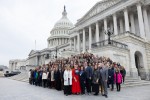
Lisa Varga writes: “Fifty years after ALA’s first National Library Legislative Day, approximately 200 library advocates from across the country gathered in Washington, D.C., for 254 visits with members of Congress and their staff.
Hosted by ALA’s Public Policy and Advocacy Office on February 25–26, the event helped kick-start the campaign to secure federal funding for library services in the 2027 federal budget. Everything you do to urge your House Representative to sign
Dear Appropriator letters will build the foundation for federal funding for library services in FY2027.”...
AL: The Scoop, Mar. 17
| |
|
Sallyann Price writes: “Bad-news fatigue is real for library advocates who feel like every year is more hostile than the one before it.
Since about 2021, coordinated groups of parents and elected officials have increasingly pushed to outsource librarians’ curatorial authority and exert greater control over what books are available on library shelves.
But in 2025, there were notable examples of voters, courts, and candidates across the country affirming the profession’s core values of intellectual freedom and inclusive access.
Below we highlight five recent victories for libraries, library workers, and their communities.”...
American Libraries feature, Mar./Apr.
| |
|
Hannah Cyrus writes: “There’s nothing neutral about Gmail, artificial intelligence, Microsoft, or Facebook.
These tools, systems, and platforms endanger our patrons and communities in ways that are both direct (subjecting them to surveillance and selling their personal information to data brokers and government agencies) and indirect (via the growing political influence wielded by their CEOs). People, whether beginners or seasoned computer users, can tell that technology is no longer working for them.
They may still be locked into some of these systems, but they are ready to start figuring out how to resist.
This is where libraries can come in.”...
Information Technology and Libraries, vol.
45, no. 1, Mar. 16
| |

|
|
|
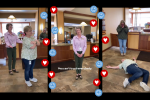
Peter Blenski writes: “On October 3, 2025, the New Berlin (Wis.) Public Library social media team posted
a video of a trust fall fail that reached millions of users, gaining attention from media outlets everywhere.
Lead Youth Services Librarian Kate Krause-Blaha said, ‘It felt very overwhelming.
We made sure to make the staff who were featured in the video more comfortable at work, as their heightened publicity was a lot to handle at the public desks.’”...
ALSC Blog, Mar. 16
| |
|
Sam Winemiller writes: “Read and publish (R&P) agreements (commonly called transformative agreements) are package subscription deals offered to academic libraries by publishers that allow an institution’s affiliated authors to receive coverage for article processing charges required to publish open access in a portfolio of the publisher’s academic journals. In their current common form, big R&P agreements ask research institutions to further sacrifice control of the scholarly communication system to for-profit publishers by incentivizing submissions to their journals.
This relationship undercuts efforts to promote author and/or institutional engagement with other open access publishing and distribution models.”...
ACRLog, Mar. 11
| |
|
Elizabeth Hambleton writes: “Indie games—titles created by small teams without the backing of a major publisher—are more numerous than the blockbuster releases.
They’re often more affordable, too, making them more appealing for library collections.
Due to their niche reach, however, many library game collections give indies a pass in favor of more well-known triple-A titles. There were more indie game releases in 2025 than any year in history, and many of them would make excellent additions to a library collection.”...
Games and Gaming Round Table, Mar.
16
| |

|
|
|
Kelly Jensen writes: “Two months into the new legislative sessions at the state level and things have gotten uglier since January’s initial roundups of bad bills.
While there are several positive things to cheer—and we should—even more concerning legislation impacting libraries has popped up or advanced.
At least 16 states had bad bills still in play.
There were seven states with good news to share—either the bill itself was good, or the concerning bill did not get the legs that far-right politicians and ‘parental rights’ advocates were hoping.” Also read
part two of the roundup....
Well Sourced, Mar. 14, Mar. 15
| |
|
Jon Severs writes: “The phrase ‘reading for pleasure’ has long been used to describe the habit of choosing to spend time reading and getting satisfaction out of it.
However, the connection of reading for pleasure to the teaching of reading in schools—and thus better academic outcomes—is a more recent occurrence.
Activity to get children reading for pleasure doesn’t seem to have made a positive difference to the number of children who enjoy reading, nor how many choose to read in their own time.
One possibility is that, while cultivating reading for pleasure is a sound ambition for schools, the pedagogy has been wrong.”...
Tes Magazine, Mar. 11
| |
|
Nick Potkalitsky writes: “If 2023 was the year of artificial intelligence’s awakening and 2024 was the year of frantic adoption, then 2025 was the year the backlash crystallized into something real.
And 2026 is shaping up to be the year when that backlash becomes a political force.
The waning of techno-futurism is not the arrival of techno-pessimism. It is something more interesting and more difficult: the slow, uneven emergence of a critical posture, one that refuses both uncritical adoption and reflexive rejection in favor of harder questions about what this technology actually does, who it serves, and what it costs.”...
Educating AI, Mar. 15
| |

|
|
|
Kalyn Gensic writes: “With
Texas’s new SB 13 looming over high school libraries, it didn’t take long before Tammy Fogle, the leader of our local Moms for Liberty group, issued 27 book challenges. After two months of sitting through board meetings dominated by Moms for Liberty, the librarian at the other high school in our district and I began inviting parents to come and voice their own perspectives, and a group formed who now attend regularly.
In interviews, Fogle seemed offended that people had organized and resisted her efforts.”...
Texas Observer, Mar. 11; Texas Library Association, July 15, 2025
| |
|
Rebecca Moore writes: “I’ve been running escape rooms twice a year for a while and always try to create or borrow one that has some connection to middle school literature.
This time, I decided to go with Stuart Gibbs’s FunJungle series of humorous mysteries involving a zoo/wildlife park in Texas.
When I’m designing escape rooms, I generally go with a single-path design, in which students can’t open boxes out of order because the clues in one box lead to another.
I look at the locks I have and figure out which ones will work best and design puzzles around them.”...
Association of Independent School Librarians Independent Ideas, Mar.
14
| |
|
Tony Phillips writes: “Don't panic! That ‘lost your Excel file’ moment is scary, but your work is probably still hiding somewhere.
From temporary files to hidden recovery folders, Excel and Windows both have safety nets—you just need to know where to look.
The trick to a successful recovery is knowing whether your file was saved to the cloud (OneDrive or SharePoint) or your local hard drive.
Work through these steps (designed for Excel on Windows) to find your lost work.”...
How-To Geek, Mar. 17
| | |

|
|
|
American Libraries Direct is a free electronic newsletter emailed every Wednesday to personal members of ALA.
Editor, AL Direct: Greg Landgraf
Direct ad inquiries to: Melissa Carr
Send news and feedback: AL Direct
All links outside the ALA website are provided for informational purposes only. Questions about the content of any external site should be addressed to the administrator of that site. AL Direct FAQ.
American Libraries will not sell your email to outside parties, but your email may be shared with advertisers in this newsletter should you express interest in their products by clicking on their ads or content. If advertisers choose to communicate with you by email, they are obligated to provide you with an opportunity to opt-out from future emails in compliance with the CAN-SPAM act of 2003 and the European Union’s General Data Protection Regulation of 2018. Read the ALA privacy policy.
To manage your American Libraries email preferences, click here.
To unsubscribe from all ALA emails, click here.
American Library Association | 225 N. Michigan Avenue, Suite 1300 | Chicago, IL 60601
|
|
|
|
|
|
|
|





.jpg)