|
On April 6, ALA
announced the 10 recipients of the
2026 I Love My Librarian Award, nominated by library users for their expertise, dedication, and impact on the people in their communities.
This year’s award recipients include three academic librarians, four public librarians, and three school librarians.
Honorees will receive a $5,000 cash prize as well as complimentary registration and a $750 travel stipend to attend
ALA’s 2026 Annual Conference and Exhibition in Chicago, to be held June 25–29. The award ceremony and reception will begin at 7:30 p.m. Central on Friday, June 26, and will
stream live on YouTube....
AL: The Scoop, Apr. 6
| |
|
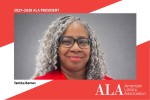
Tamika Barnes, associate dean of Perimeter College Library Services at Georgia State University in Atlanta, has been elected 2026–2027 president-elect of the ALA.
The Association made the announcement April 6. Barnes received 3,827 votes, while her opponent, Becky Calzada, district library coordinator at Leander (Tex.) Independent School District, received 2,742 votes. In her
candidate statement, Barnes pledged that her presidency would focus on four pillars: unified advocacy; inclusive leadership and professional growth; equity, access, and intellectual freedom; and transparency and stewardship....
AL: The Scoop, Apr. 6; American Libraries column, Mar./Apr.
| |
|
Rosie Newmark writes: “Traveling alone through Cincinnati/Northern Kentucky International Airport, a woman wandered the concourse looking to pass the time.
Then she spotted a sign for the Airport Library, where she plugged in her devices and picked up a historical biography she said she never would have chosen under normal circumstances.
In recent years, public libraries across the country have begun partnering with airports to bring books, digital materials, and dedicated reading spaces into terminals, offering travelers a free alternative to a shop or restaurant and a rare moment of calm amid the bustle of travel.”...
American Libraries Trend, Mar./Apr.
| |

|
|
|
The White House’s proposed fiscal year 2027 federal budget released April 3 eliminates funding for the Institute of Museum and Library Services (IMLS), the school library program Innovative Approaches to Literacy (IAL); and several library-eligible programs. A response from ALA President Sam Helmick said, in part, “The president has repeatedly underestimated congressional support for libraries and the lengths to which advocates will go to protect library services.
Thanks to library advocacy, Congress
increased library funding last year, just as it did all four years of the president’s first term.” ALA is urging library supporters to
contact their congressmembers in support of IMLS and IAL funding....
ALA Public Policy and Advocacy Office, Apr.
3; American Libraries Online, Feb.
6
| |
|
A supermajority of ALA employees formally requested that ALA management voluntarily recognize their union,
ALA Workers United, in a letter delivered to ALA Executive Director Dan Montgomery March 30. “Voluntary recognition is an established process that allows workers to freely exercise their right to choose union representation without the unnecessary duplication and delay of an election,” according to a statement from union leaders.
Employees have also filed a petition with the National Labor Relations Board to trigger an election if the union is not voluntarily recognized....
AFSCME Council 31, Apr. 2
| |
|
Samantha Ingerson writes: “The first day of a conference is always incredibly exciting… and incredibly tiring.
However, there is something very different about the Public Library Association Conference.
I’m not sure what it is: seeing different librarians from different states who have the same ideas as you, learning new things, or maybe it’s just exciting because it’s exciting. Either way, day one didn’t disappoint.” Find recaps of sessions on
advocacy,
serving migrant families,
fat-inclusive libraries,
teen spaces, and
more....
ALSC Blog, Apr. 1–3
| |

|
|
|
Elizabeth Szkirpan writes: “In a field shaped by strong values, many librarians cite ethical concerns with labor, copyright, privacy, and the environmental impact of artificial intelligence (AI). Some professionals are shirking it altogether.
However, as vendors continue to integrate AI into library platforms, patrons increasingly rely on these tools for everyday tasks, and institutions commit to AI-forward strategies, complete disengagement is not an option for today’s librarian. So, what does ethical AI interaction look like in a role where you can’t ignore or cut it out altogether? Balance is key.”...
Choice 360 LibTech Insights, Apr.
6
| |
|
Rebekkah Smith Aldrich writes: “Building on the work of the ALA Task Force on the Environment (formed in 1989) and the momentum of the Sustainability Round Table (formed in 2013), ALA Council passed the
Resolution on the Importance of Sustainable Libraries in 2015. The resolution suggested the beginning of a ‘new era.’ That was a bold statement—and once it made, it called for action.
Fortunately, the right leadership was in place at the right time.”...
ALA150, Apr. 2
| |
|
Claire Woodcock writes: “Conservative parents’ advocacy groups have been experimenting with using commercially available AI tools to help them flag more books they’ve deemed pornographic to be removed from public schools and libraries.
Even though LLMs are notoriously error-prone, and the books in question aren’t pornographic, these groups continue to explore use cases for AI anyway.
One such experiment indicates a desire to accelerate content production of book reviews for conservative book-rating sites and explicitly defines ‘educational inappropriateness’ as ‘content offensive to conservative values.’”...
404 Media, Apr. 1
| |

|
|
|
Stephanie Gamble writes: “When I first started as a school librarian I had a lot of frustrations with the 300s. Arriving in my grade 9–12 library after a history PhD and years at research universities, I chalked up my frustrations with Dewey—especially the way the 300s pulled critical aspects of history out of ‘History’ when it involved minority groups—to a need to break my old Library of Congress Classification habits.
But why do we use Dewey? Our mission is to prep our students for college level research, but we aren’t teaching them college library organization.”...
AISL Independent Ideas, Apr.
1
| |
|
Daisy Auger-Domínguez writes: “Workplace burnout is often discussed as if it were a single condition with a single solution: fewer hours, better boundaries, more resilience.
That framing is incomplete and misleading.
Burnout takes different forms depending on where someone sits in the organization; what they’re accountable for; and how much clarity, control, and moral alignment they have.
Burnout is rarely a personal failure.
It is usually a design failure.
When capable, committed people are exhausted, the issue is not resilience—it is work engineered without regard for human limits and systems that quietly reward overextension.”...
Harvard Business Review, Apr.
3
| |
|
Adaeze Uche writes: “There are only a few people who learn Excel in an academic setting. Most of us pick it up as we go, learning just enough to get through whatever task is in front of us. It’s great that we can build our Excel skills this way, but we also tend to pick up inefficient habits. Once you identify and unlearn them, you put yourself in position to use Excel more effectively.”...
MakeUseOf, Apr. 5
| | |

|
|
|
American Libraries Direct is a free electronic newsletter emailed every Wednesday to personal members of ALA.
Editor, AL Direct: Greg Landgraf
Direct ad inquiries to: Melissa Carr
Send news and feedback: AL Direct
All links outside the ALA website are provided for informational purposes only. Questions about the content of any external site should be addressed to the administrator of that site. AL Direct FAQ.
American Libraries will not sell your email to outside parties, but your email may be shared with advertisers in this newsletter should you express interest in their products by clicking on their ads or content. If advertisers choose to communicate with you by email, they are obligated to provide you with an opportunity to opt-out from future emails in compliance with the CAN-SPAM act of 2003 and the European Union’s General Data Protection Regulation of 2018. Read the ALA privacy policy.
To manage your American Libraries email preferences, click here.
To unsubscribe from all ALA emails, click here.
American Library Association | 225 N. Michigan Avenue, Suite 1300 | Chicago, IL 60601
|
|
|
|
|
|
|
|






.jpg)