|
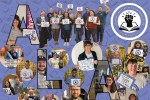
Rosie Newmark writes: “About 100 employees at ALA began voting on April 24 to form ALA Workers United (ALAWU), a new union at the 150-year-old association. If a majority of the 101 eligible staff members out of 161 ALA employees vote to unionize, the National Labor Relations Board will certify the new union.
Votes will be counted May 27. A
March 2 open letter cited several reasons for unionizing, including increased workloads, benefit reductions, financial crises, ingrained salary disparities, and a lack of transparent decision making.”...
American Libraries feature, Apr.
29
| |
|
Allison Escoto writes: “Fundraising is a perennial concern for libraries of all types and sizes, regardless of location. With federal funding increasingly threatened, library professionals will be called on to source money for collections, programming, and beyond. These titles are valuable resources and guides through the labyrinthine process of fundraising.”...
American Libraries column, Mar./Apr.
| |
|
Gena Parsons-Diamond writes: “ACRL announces the publication of the report
The State of US Academic Libraries: Findings from the ACRL 2024 Annual Survey. Results show academic libraries adapting to a rapidly shifting information landscape and expanding access for users.
While disparities in staffing and funding persist across institution types, libraries continue to play a vital role in supporting research, instruction, and student success.
This report focuses on US academic libraries in the 2023–2024 academic year. For the first time, this year the results are weighted to be representative of all US academic libraries.”...
ACRLog, Apr. 22
| |

|
|
|
Amanda Galliton writes: “‘Know your worth’ is one of those phrases that sounds simple but can feel complicated in practice.
As school librarians, I think many of us actually do know our worth.
We see it every day in our libraries.
The harder part is when other people don’t see it. School librarianship is full of work that doesn’t always show up in obvious ways.
A lot of that happens behind the scenes or in moments that are easy to miss if you’re not paying close attention.
Because of that, our work is easy to misunderstand or underestimate.”...
Knowledge Quest, Apr.
28
| |
|
Erika Hogan writes: “April is National Poetry Month.
From picture books with poems to novels in verse for middle-grade readers and fun activities, there are so many ways to involve poetry in library plans.
Research shows that poetry is good for the brain.
Creative language use builds pro-social skills like self-awareness and empathy.
Poetry encourages word play, and the use of rhyme, rhythm, and meaning-making means poetry also
plays a role in building literacy skills. Poetry also involves a lot of white space on the page, which can build confidence and reading success for reluctant readers.
Poetry is where it’s at!”...
ALSC Blog, Apr. 26; Greater Good Magazine, Apr.
8, 2025; Scholastic Parent, June 7, 2022
| |
|
Elaine Kong writes: “For a long time, library discovery followed a familiar model: Users entered a query, reviewed a list of results, and made their own judgments about relevance and credibility.
Generative AI changes that balance.
Newer systems can summarize articles, suggest themes, translate questions into search strategies, and produce responses that feel closer to answers than result lists.
That may help users get started more quickly, but it also means the interface is no longer just a pathway into the collection.
It is becoming part of how the collection is understood.”...
Information Matters, Apr.
17
| |

|
|
|
Brian Lavoie writes: “Libraries have a long-standing value proposition centered around collections—a perception that has persisted even as libraries have developed new offerings across a wide range of emerging areas of research support.
Fixed ideas about library roles and impact create a challenge: Institutional stakeholders often don’t understand service offerings in these new areas.
OCLC Research’s new report,
The Library Beyond the Library: Recasting the Library Value Proposition for Visibility and Impact, helps libraries navigate these trends by providing a framework and insights that support strategic planning aimed at elevating the library’s visibility and impact within its parent institution.”...
OCLC Research, Apr. 27
| |
|
Madison Dearnaley writes: “You’ve probably said it a thousand times: ‘If you don’t like reading, you just haven’t found the right book yet.’ But I don’t believe finding the right book is the only key, so I’ve started to adjust my saying.
I also suggest they may not have found the right format, they may face challenges that make reading hard and might need extra help, or they may need to work through some of the things they’ve been told that are not true.
I’m having far more open, honest, and helpful conversations with my students.”...
Madison’s Library, Apr. 27
| |
|
Jake Peterson writes: “I don’t think artificial intelligence (AI) voice generation is inherently bad.
But in my humble opinion, art isn’t usually a proper use case for AI voices.
If I choose to listen to an audiobook, I am almost assuredly looking for an experience.
I want a narrator with a talent for dramatic reading, someone who will be able to voice all the different characters, tap into inflections and emotions, and sell me on the story I’m listening to. Luckily, it’s not hard to identify AI narration on Libby—assuming the publisher has labeled its books properly.”...
Lifehacker, Apr. 21
| |

|
|
|
Rhea Kelly writes: “Institutions working to meet the Americans with Disabilities Act Title II
regulations for digital accessibility [requiring public entities to ensure that web content conforms with WCAG 2.1 Level AA accessibility standards] have received a temporary reprieve: The US Department of Justice has published an
interim final rule to push back the compliance deadline by one year,” to April 26, 2027, for public institutions serving a total population of 50,000 or more, and April 26, 2028 for institutions serving smaller populations....
Campus Technology, Apr.
27; American Libraries feature, Mar./Apr.
| |
|
“Brooklyn (N.Y.) Public Library on April 23 released
250 for 250, a librarian-curated list of the 250 most notable books from 250 years of American history, reflecting on the pivotal role books and stories have played in shaping the country we are today.
Starting with Thomas Paine’s Common Sense, the list includes books published between 1776 and 2025. A committee of nearly two dozen librarians made the final selections.
They considered well over 600 books in their discussions, working to create a list that reflects the breadth and depth of America’s stories.”...
BK Reader, Apr. 24
| |
|
Christian Kriticos writes: “In an era before the printing press, books were a valuable commodity.
They could take months to produce, as the entire text had to be painstakingly written out by hand.
So, just as universities solicit cash from their alumni today, Merton College in Oxford, England, insisted its 13th-century fellows donated books.
The Archbishop of Canterbury issued a decree in 1276 introducing this requirement, which marked the beginning of the library at Merton College.
Merton's library predates the Aztec Empire, and its users have encompassed everyone from famous 14th-century mathematicians to Lord of the Rings author J. R. R. Tolkien.”...
BBC, Apr. 23
| | |

|
|
|
American Libraries Direct is a free electronic newsletter emailed every Wednesday to personal members of ALA.
Editor, AL Direct: Greg Landgraf
Direct ad inquiries to: Melissa Carr
Send news and feedback: AL Direct
All links outside the ALA website are provided for informational purposes only. Questions about the content of any external site should be addressed to the administrator of that site. AL Direct FAQ.
American Libraries will not sell your email to outside parties, but your email may be shared with advertisers in this newsletter should you express interest in their products by clicking on their ads or content. If advertisers choose to communicate with you by email, they are obligated to provide you with an opportunity to opt-out from future emails in compliance with the CAN-SPAM act of 2003 and the European Union’s General Data Protection Regulation of 2018. Read the ALA privacy policy.
To manage your American Libraries email preferences, click here.
To unsubscribe from all ALA emails, click here.
American Library Association | 225 N. Michigan Avenue, Suite 1300 | Chicago, IL 60601
|
|
|
|
|
|
|
|





.jpg)